This translation was generated using artificial intelligence. We strive for accuracy and quality, but automated translations may contain errors. You can read the original text here.
The list of myths and misconceptions we write about did not come about by chance. We talked to Belarusians — discussed personal experiences, listened to stories, and exchanged opinions. Then we analyzed what we heard, identified key ideas, and compared them with the opinions that dominate the media, public discussions, and politicians’ statements. We became convinced that myths about the Belarusian economy do indeed exist.
In order to dispel them, we have gathered facts, research, and observations that we believe can form the basis for an open conversation about what our country is today. Written by Raman Shcherba and Maria Ziaziulina.
Myth 1: State ownership dominates the Belarusian economy
This is one of the most common misconceptions about the Belarusian economy. It has been shaped by statements made by politicians and experts, as well as propaganda. An example of this is the opinion of employees of the National Economic Research Institute under the Ministry of Economy that state ownership dominates the Belarusian economy.
Share of the state and private sectors in Belarus’ GDP
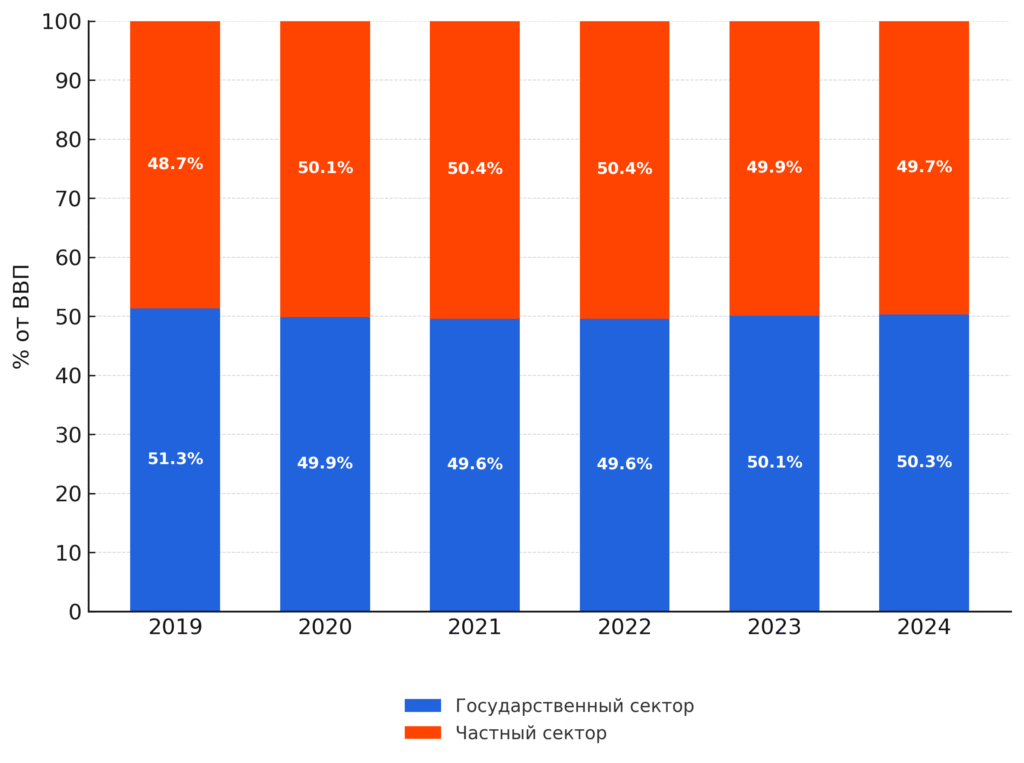
Belstat data for 2019-2024 show that the shares of the state and private sectors are almost equal, and in some years private ownership prevailed, albeit insignificantly — the advantage was less than one percent.
According to international practice, the public sector includes enterprises with more than 50 percent state ownership, but Belarusian official statistics include even those organizations where the state’s share is significantly smaller. It turns out that if international standards were applied, the share of the private sector in the Belarusian economy would be higher.
The role of the public sector in the Belarusian economy
(as a percentage for the first six months of 2025)
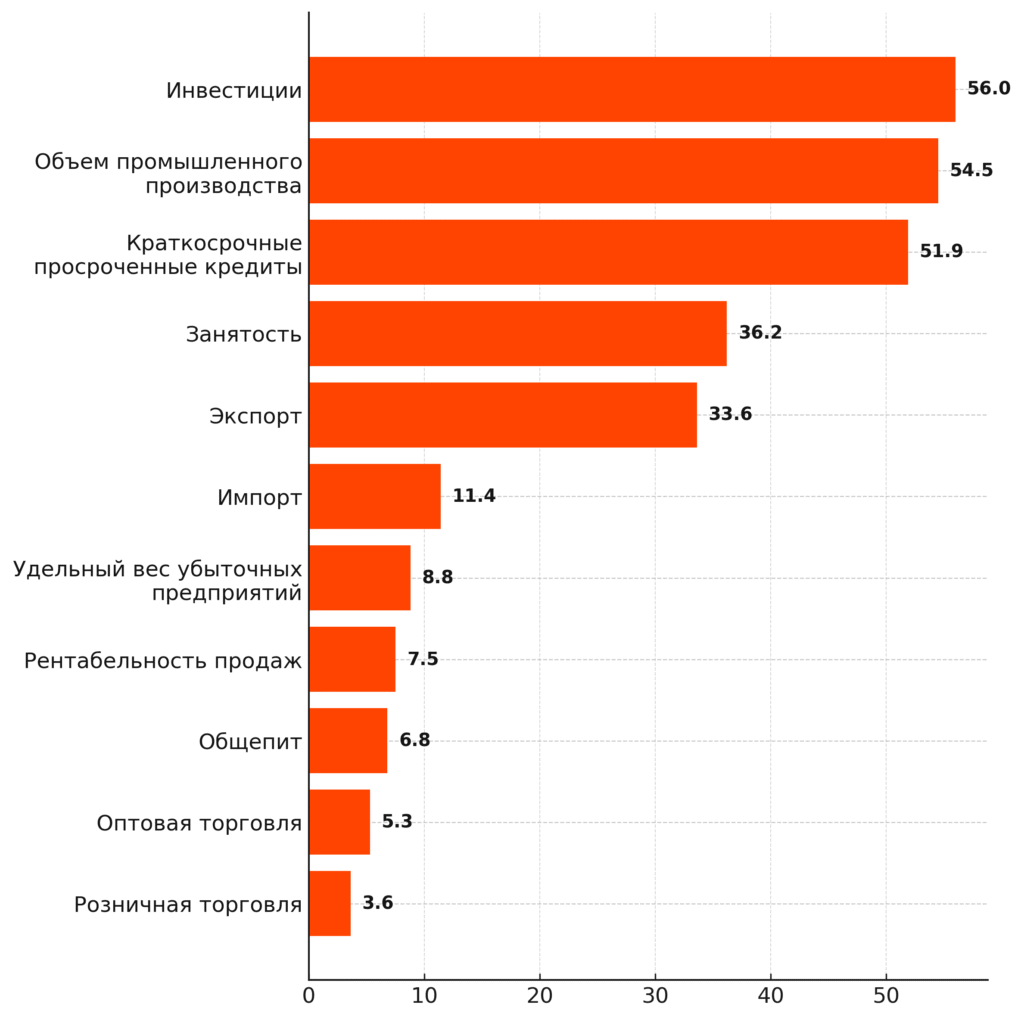
State-owned enterprises are most important in industry, accounting for 54.5% of total production, while the private sector dominates in more profitable sectors such as trade, catering, and export-import operations. This shows that it is the private sector that creates most of the added value and income in the country’s economy, refuting the view that the state sector predominates.
At the same time, the share of state ownership in the economy has declined without full-fledged privatization. This has been achieved through the growth of the private sector “from below” in trade, services, and industry, the reduction of the influence of state-owned enterprises in the market, and the emergence of mixed ownership with private capital participation.
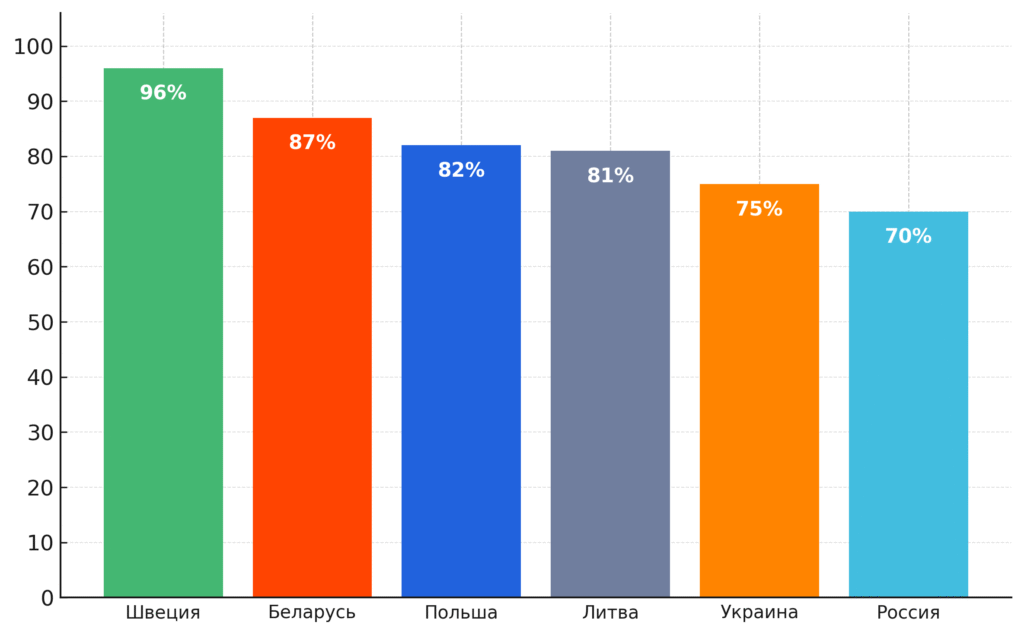
This path of privatization from the bottom up largely reflects the value system of Belarusian society, which is oriented towards entrepreneurial activity. According to the Atlas of European Values, Belarusians have a positive attitude towards increasing the share of private property in the country’s economy – it is at a level comparable to Sweden.
Most likely, the share of private ownership in business should be greater
(Percentage of respondents who agree with the statement)

Myth 2: Belarusians are the same as Russians!
It is sometimes said that Belarusians are “white Russians” or something similar. Alexander Lukashenko has repeatedly noted the similarity between Belarusians and Russians, and has even called them essentially one people. A significant portion of Russians share this view. It is telling when Russians visiting Belarus are surprised by signs in the Belarusian language and a different currency.
In this article, we do not consider national differences but compare the value systems of Belarusians, Russians, and residents of neighboring countries.
Belarusians are significantly more likely than residents of neighboring countries to consider a democratic political system a good idea to some extent. In this respect, Belarusians are significantly closer to Western European countries.
Having a democratic political system would be a very good or fairly good idea
(Percentage of respondents who agree with the statement)
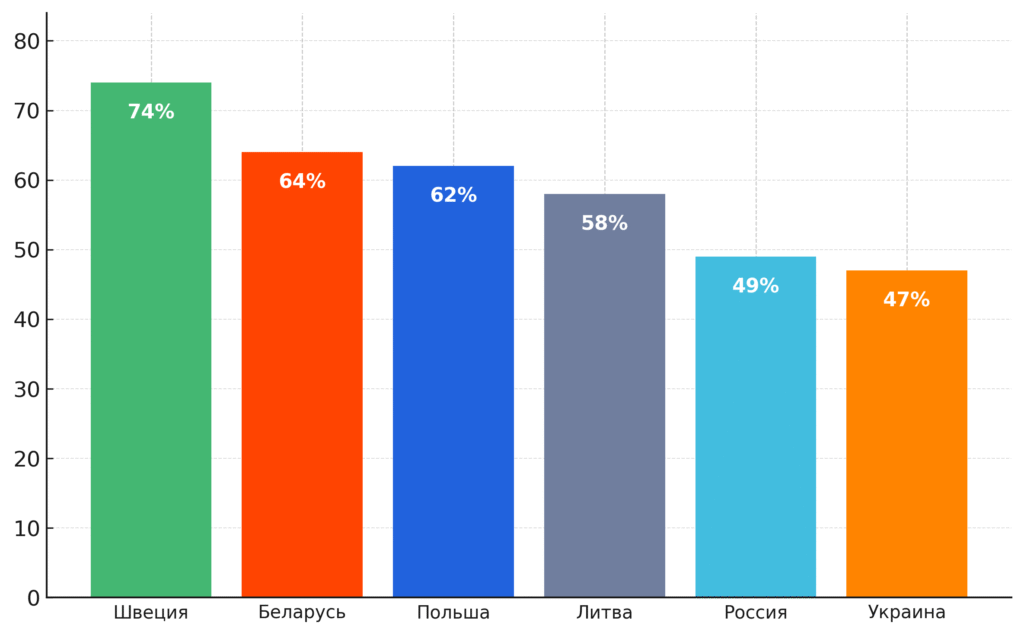
Belarusians are more likely than Poles and Lithuanians to view competition as a positive phenomenon, while Russians and Ukrainians have a more negative attitude toward competition.
Competition is most likely a good thing
(Percentage of respondents who agree with the statement)
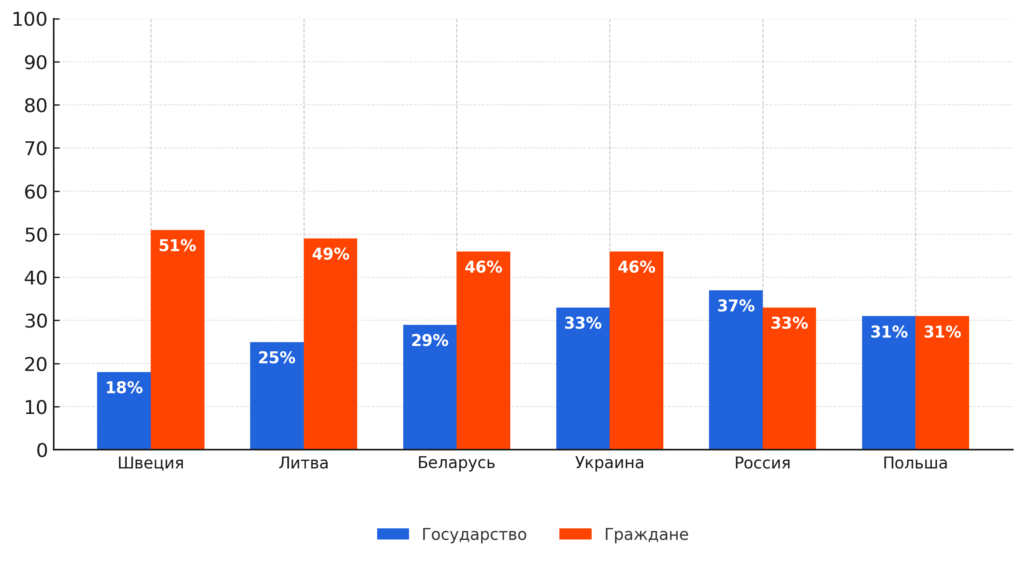
Belarusians also believe that people should bear more responsibility for their own welfare than the state. The same view is held in Ukraine, Lithuania, and Sweden, while in Russia and Poland, people are more likely to believe that the state should take greater responsibility for the welfare of its citizens.
Who should be responsible for providing for citizens: the state or citizens themselves?
According to the Global Entrepreneurship Monitor (GEM), the percentage of early-stage businesses operating in medium- and high-tech sectors in Belarus is higher than the average for high-income countries.
In the GEM 2020 ranking, Belarus ranks 15th, ahead of all its neighbors except Poland (10th place) and significantly ahead of Russia (69th place). This index shows the extent to which citizens support private initiative, entrepreneurship, and independence in the economy.
Thus, the stereotype that Belarusians and Russians are one people in terms of economic values does not correspond to reality. Belarusians demonstrate strong support for entrepreneurship, private property, competition, and democratic values, and in a number of indicators, their positions are comparable to those of residents of countries with highly developed economies.
Myth 3: Belarus cannot survive without Russia
There is a widespread belief that Belarus is completely dependent on Russia economically, which is its main and, in fact, only market.
According to Belstat data, between 2015 and 2021, Russia’s share of Belarusian exports remained at 38–46%. In 2018 and 2019, this share was minimal, at 38% and 42%, respectively, indicating Belarus’ attempts to reduce its dependence on the Russian market.
Exports of goods: main trading partners (2019)
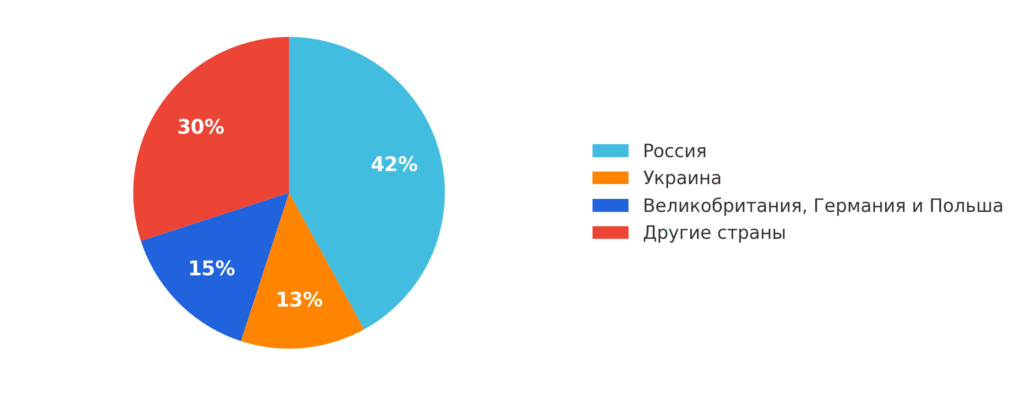
In the structure of Belarus’ exports of goods in 2019, about 42% went to the Russian Federation, 13% to Ukraine, 15% to the United Kingdom, Germany, and Poland, and about 30% of the country’s foreign trade went to countries outside the CIS. In other words, despite the continued significant role of the Russian market, Belarus diversified its export destinations and increased its presence in the markets of the European Union, China, and a number of Asian countries.
After 2020, the diversification process stalled due to political events in the country and the sanctions imposed on it. After the start of the war in Ukraine, supplies to the Western market virtually ceased, forcing Belarus to reorient itself to other markets.
Although any process of export reorientation is usually accompanied by economic shock, Belarus has coped with this challenge quite effectively. This demonstrates the high adaptability of the Belarusian economy and its potential for successful reorientation of export flows in the future.
Myth 4: Belarus is an IT country
In 2019, Western media outlets called Belarus “The Silicon Valley of Eastern Europe,” “The World AI Development Center,” and so on. Belarus became an IT country thanks to its intellectual and technical potential and consistent state support within the framework of the High-Tech Park (HTP). HTP residents were exempt from income and value-added taxes, had reduced social security contributions, could hire foreign employees, and enter into contracts with foreign clients directly. These incentives stimulated the inflow of investment and personnel into the IT sector.
In five years, the number of product companies in the High-Tech Park grew 14 times: from about 20 in 2017 to more than 300 in 2020. At that time, the IT sector employed about 60,000 people, which accounted for almost 2% of all those employed in the Belarusian economy.
Belarus is known for its large IT companies, such as EPAM Systems, Wargaming, Flo, PandaDoc, and others. In 2021, IT services exports reached approximately $3.2 billion, and the share of the information and communication technology (ICT) sector in the country’s GDP was 7.4%. Thanks to these changes, Belarus ranked third among the countries in the region in terms of this indicator, becoming one of the leaders in Europe.
Share of information and communication technologies (ICT) in countries’ GDP (2021)

In recent years, investors, fearing the loss of their capital, have begun to withdraw it from Belarus, along with their teams of employees. But even so, Belarus still has a fairly large IT sector, and together with Belarusians working in the sector outside the country, we remain an IT nation. It turns out that the myth corresponds to reality.
Myth 5: Belarus is a small rural country
One of the most common myths about Belarus is the perception of it as a “collective farm” country, where most of the population lives in villages and is engaged in the agricultural sector of the economy. This myth is complemented by the opinion that Belarus is a small country. Alexander Lukashenko set the tone for the expression “small country” when he once called Belarus a “patch of land.“
Let’s start with rurality. According to data from the National Statistical Committee of Belarus (Belstat), in 2024 the urban population will be about 7.2 million people, while the rural population will be only 1.9 million. In other words, the urban population significantly exceeds the rural population, accounting for 79% of the total population. [19] The growth in urbanization can be traced over the last three decades; in 1990, 66% of the population lived in cities.
Share of urban population in Belarus (1990-2025)
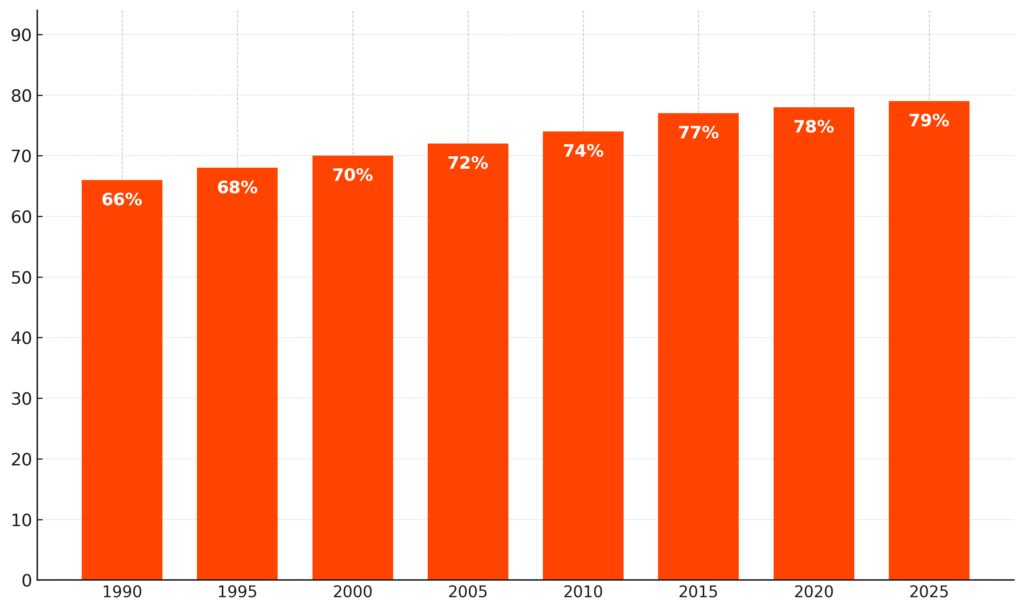
It turns out that Belarus is a highly urbanized country. The level of urbanization is higher than in Russia (75%), Ukraine (69%), Poland (60%), Lithuania (68%), and a number of European Union countries.
When talking about the size of Belarus, it is important to note that Belarus is one of the largest countries in Eastern Europe, and among all European countries, it is one of the medium-sized ones, ranking 13th in Europe in terms of area. Its territory is about 207,600 square kilometers. This is larger than the territories of many European countries, such as Austria (84,000 km²), the Czech Republic (79,000 km²), Portugal (92,000 km²), Belgium (31,000 km²), and Switzerland (41,000 km²).
In terms of population, Belarus is not a “small” country either. According to Belstat, in 2024, the country will have a population of about 9.1 million, which is larger than Switzerland (8.8 million), Denmark (5.9 million), or Norway (5.5 million).
Conclusion
We come to the conclusion that Belarus is a predominantly urban country with an economy in which the private sector plays a significant and, in many areas, leading role, despite persistent myths about the dominance of the public sector. Belarusians are focused on private initiative, competition, and personal responsibility, demonstrating support for democratic principles and a desire for independence. Belarusians are an enterprising people, and until recently, the country was one of the notable centers of IT development in the region.
This material is only a starting point for further dialogue and research. To form a truly accurate and multifaceted image of Belarusians, it is important to continue listening, discussing, and looking at Belarus not through the prism of external perceptions.
