This translation was generated using artificial intelligence. We strive for accuracy and quality, but automated translations may contain errors. You can read the original text here.
When considering possible scenarios for Belarus’s future, one of the most likely catalysts for change is the departure of Aliaksandar Lukashenka from power. That event would trigger a transformation process that is currently stuck in a dead zone — frozen in place.
While the future is unknown to anyone, we can try to extrapolate from today’s political dynamics to model the likely actions of key political actors. Based on this logic, I would risk offering several conclusions.
Transition in the Form of Crisis
In personalized authoritarian regimes like the one in Belarus, there is no mechanism for the orderly transfer of power — even within the ruling elite, let alone to the opposition. As a result, the ruler’s exit almost inevitably leads to a political crisis.
Once the leader is gone, the regime cannot continue in its current form. After all, this is a system of personal rule. The entire structure of institutions and power mechanisms has been tailored to one individual — modeled in his image and likeness, and entirely centered on him. In such a model, the figure at the top is irreplaceable. Lukashenko is the linchpin. His removal would set off a regime transformation and open a window of opportunity.
Discussions about political transition usually focus on how Lukashenka’s inner circle might behave. Undoubtedly, the ruling nomenklatura will try to become a political actor in its own right. At the moment, it serves merely as an instrument in Lukashenka’s hands. But it has interests of its own — interests that are currently being suppressed. These interests differ across elite factions, and tensions among them are likely to emerge.
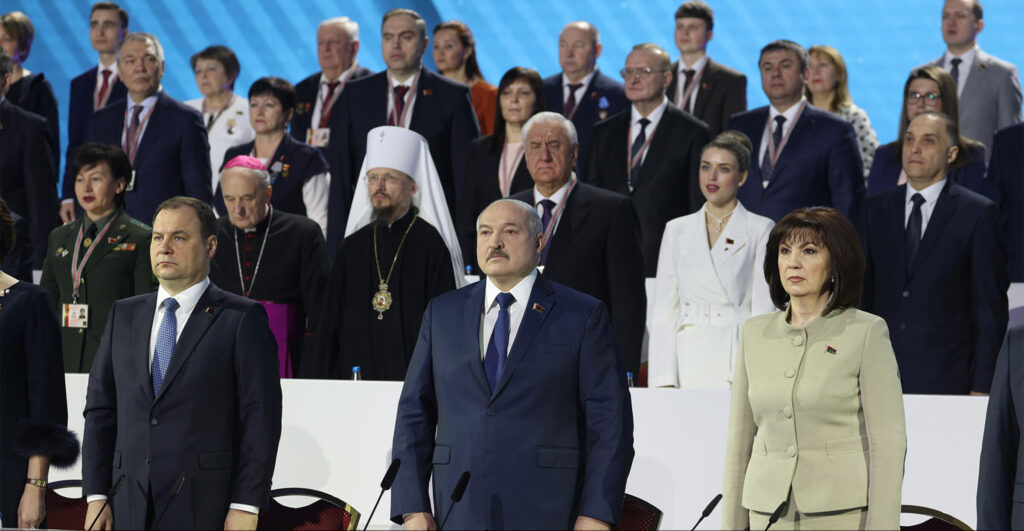
This is even more likely given that Lukashenko introduced constitutional changes that have further complicated the political system. By granting the All-Belarusian People’s Assembly (ABPA) constitutional powers, he disrupted the existing balance of power. Right now, all key decisions are still made by Lukashenka, while the rest of the institutions remain dormant. But in his absence, a power struggle could erupt — between the president, the government, the parliament, the ABPA, and the Constitutional Court. Moreover, during the transition period, the Security Council has been granted considerable authority.
In a country with fragile democratic traditions, such systemic imbalance is more likely to deepen the crisis than to resolve it.
The Inevitable De-Lukashenkaization
Discussions about the transition tend to focus on what the ruling elite will do once Lukashenka is gone. The people themselves are usually left out of the equation, their influence disregarded. Within the current status quo, society is not seen as a political force.
However, this outlook is based on today’s circumstances. What it fails to consider is that Lukashenka’s departure would dramatically change the situation. Since he currently makes all significant decisions, his disappearance would create a temporary state of paralysis—perhaps even a vacuum. At that moment, political actors currently not being considered could step onto the stage. For example, the people of Belarus themselves. The opposition, now concentrated abroad, would also try to reclaim its role as a political force.
The experience of North Korea, Azerbaijan, Syria, and other Asian dictatorships—where power transfers smoothly from one individual to another, often father to son—does not apply to Belarus. The reason is simple: Belarus went through 2020. That year revealed a modernized society oriented toward change, eager to break free from state paternalism, and a regime determined to freeze the status quo. Belarusian society has outgrown the state; it no longer fits within its confines. Even though the forced emigration of hundreds of thousands of people has altered the country’s social and political makeup, the internal potential for reform remains. In a brief period of inevitable power vacuum, society may once again try to assert itself as a political force.
A new leadership will have no choice but to begin the process of de-Lukashenkaization to gain domestic legitimacy. The country is deeply entrenched in authoritarianism; public sentiment has been pushed to extremes in that direction. And by the laws of physics and politics, it must begin to swing back.
Belarus is ripe for change—and the only real obstacle is a single person. A parallel can be drawn with the Soviet Union after Stalin’s death. The dictator’s inner circle instinctively understood that legitimacy and support from society, the party, and the state apparatus could only be regained through destalinization. That’s why leaders like Lavrenty Beria, Georgy Malenkov, and Nikita Khrushchev took increasingly bold steps in that direction.
The Russian Factor
It goes without saying that external forces will actively intervene in the political process — first and foremost, Russia.
Here, we are confronted with a serious and, in many ways, intellectual rather than purely geopolitical challenge. Within the Belarusian democratic community — as well as among Western elites — a fatalistic belief has taken root: the belief that the fate of Belarus is entirely dependent on the will of the Kremlin. That Russia’s influence is so overwhelming that Moscow will simply install its own candidate in Belarus, with little consideration for the views of the Belarusian people. According to this logic, change in Belarus is impossible without regime change in Russia itself.
Few doubt that Moscow will attempt to influence the transfer of power in Belarus. However, such an outcome is by no means predetermined.
To begin with, there is no precedent in modern Russia for installing a hand-picked protégé at the head of another post-Soviet state. Russia has repeatedly intervened to support already existing pro-Russian candidates or parties, but sending in a modern-day Mikhail Muravyov acting as a de facto colonial governor — as it did in 1863 to crush the uprising led by Kastuś Kalinoŭski — is highly unlikely. After all, any successor to Lukashenka would still have to be presented through a formal presidential election. And as the events of 2020 made clear, even tightly controlled elections carry the inherent risk of political upheaval.
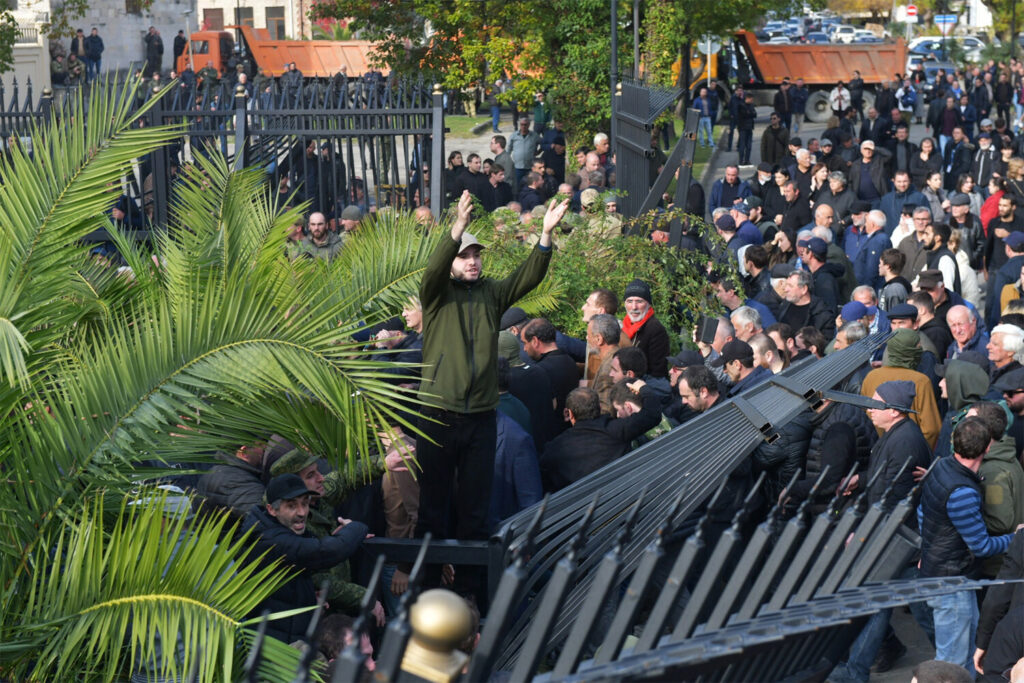
Consider Abkhazia: even there, with Russia exercising far more leverage than it does in Belarus, a protest movement led to a change in leadership last year — and nothing catastrophic happened.
In small countries dependent on larger powers, political power is shaped by its own set of rules. To preserve stability, leadership requires dual legitimacy: one rooted in support from the empire (in this case, Russia), and the other — however limited — in the backing of the local population and elites. During the Soviet era, every leader of a socialist republic sought not only Moscow’s approval but also a degree of domestic popularity.
For any new leader, gaining public legitimacy from scratch will be a major challenge. State security services alone — the KGB or GUBAZiK — won’t be enough. It’s worth remembering that Lukashenka himself needed two years (1994–1996) of intense struggle with the Supreme Soviet and the Constitutional Court before he fully consolidated power. A successor will need time to establish themselves as well — and without support from both the nomenklatura and the public, this will be difficult. Relying solely on Moscow would place any future leader on politically unstable ground.
The West and Belarus
It can be assumed that the West has also learned lessons from recent years and will engage more actively in supporting democratic transformation in Belarus.
Initially, Western reactions to the 2020 political crisis in Belarus were slow and cautious, viewing it largely as a domestic humanitarian issue. However, it has since become clear that the unresolved internal conflict has spilled beyond Belarus’s borders, creating a broader problem of regional and international security. The Belarusian political crisis has acquired a geopolitical dimension and has become a source of global tension. As long as the Lukashenka regime remains in power, the country will continue to pose threats to its Western neighbors.
The key takeaway is this: there is no fatal inevitability to Belarus’s future. The country’s trajectory will depend on the engagement and agency of all political actors — both within Belarus and beyond.
