This translation was generated using artificial intelligence. We strive for accuracy and quality, but automated translations may contain errors.
Pavel Matsukevich writes about cultural heritage that has vanished without a trace and an identity that has emerged from nowhere.
Simeon Polotsky and Kazimierz Siemienowicz — which of them is one of our own, and which a traitor?
Both were born on the territory of modern-day Belarus, were ahead of their time, and held humanistic views in historically unfavourable circumstances. One of them — Polotsky — entered the service of the Russian tsar, while the other served his own master: the King of Poland and Grand Duke of Lithuania 1.
To serve the Russian tsar who captured Polotsk is shameful. Like working for Putin and Russia. That is how it is perceived today. That is why you can sometimes hear it said that Simeon Polotsky was a traitor and a collaborator.
This is the problem with Belarusian history: we still find it difficult to understand what exactly is “ours.”
Polotsky, like Siemienowicz, lived in the seventeenth century. It was an entirely different reality — different values, a different meaning of life, different attitudes towards faith, one’s master, and the state. They cannot be judged by modern standards.
However, another important question arises: what does any of this have to do with Belarus? It is voiced openly in debates such as “whose Kosciuszko or Mickiewicz is it?” The argument goes that the discussion concerns the Grand Duchy of Lithuania, the Polish-Lithuanian Commonwealth, the Russian Empire, and any number of others — but Belarus is nowhere to be found on this list.
All of this creates the impression — especially from the outside — that our country exists as an echo of a foreign past: Russian, Polish, Lithuanian 2.
The history of Belarus as an independent state is indeed still short, but as the history of a land and its people, it is long and deep. All of this is Belarus, albeit under different names and as part of various states.
Cultural heritage could attest to this. But it has, unfortunately, been almost entirely lost.
The question is not only of how and where it vanished. It is also what we ourselves know about it and what we are capable of recovering. Cultural heritage is not a supplement to history, but its most crucial evidence. And that evidence is missing.
Belarus — a Regional Donor of Values
So asserted Professor Adam Maldzis: for centuries, as part of various political entities, Belarus was “doomed to the voluntary or forced removal of a significant part of its material and spiritual and cultural treasures” to capitals and cultural centres that today lie outside its borders.
Russia can be considered the leader of this historical marathon, though all of Belarus’s neighbours joined in the removal of its cultural treasures — as did the Germans, Swedes, and French.
A telling example: there is not a single copy of Symon Budny’s Catechism, published in 1562 in Nesvizh, anywhere in Belarus — and this was the first book in the Belarusian language to be printed on Belarusian soil. Eight of the ten surviving copies of this rare early printed book are held in Russian libraries. The remaining two are in Kraków and Prague.
It is believed that Belarus has lost up to 99% of its national cultural treasures. This staggering figure was cited by Belarus’s first Foreign Minister, Pyotr Krauchanka.
Perhaps it is because of such losses — even if they are exaggerated — that the perception arises that the Grand Duchy of Lithuania is modern-day Lithuania, the Polish-Lithuanian Commonwealth is Poland, and everything else is Muscovy, the Russian Empire, or the USSR. That Belarus is only 30 years old: that Belarusians somehow appeared out of nowhere, like an airborne force, on a mission to build a country from scratch.
Moreover, historical circumstances have subjected us to Russification, Polonisation, and even Germanisation. We survived, and we even have our own nation-state. But this does not dispel the confusion — both among outsiders and among ourselves — about who we are.
What Should Be Considered Belarusian?
Belarusian cultural boundaries are contested by neighbours; one may recall the conflict with Poland over the inscription “to the distinguished son of Belarus” on the Belarusian monument to Kosciuszko in Solothurn. But these boundaries must be defined by ourselves. The criterion here can be quite simple: anything related to our territory can be considered Belarusian in a cultural sense.
This was more or less the view of Uladzimir Shchasny, a well-known Belarusian diplomat and art historian who headed the national UNESCO commission.
Territorial origin determines to whom cultural treasures belong. Kosciuszko, Mickiewicz, and Moniuszko are therefore ours as well, since they were born on the territory of present-day Belarus. “As well” — because they are also Polish and Lithuanian. They, and others like them, are a world heritage born of Belarusian soil.
We have the right to claim a place in our cultural space for all outstanding figures who hail from the cities, villages, and towns of Belarus and became famous abroad.
At the same time, it is worth knowing the heritage we are reclaiming for the Belarusian context: the music of Ogiński or Moniuszko, the paintings of Gluckman or Lubitsch, the life of Mineyko or the works of Ursyn-Niemcewicz. Heroes belong to those who cherish their memory.
It is also telling that they all existed and worked in different languages — Russian, Polish, French — but not in Belarusian. Yet this tells us nothing about their identity, let alone how they personally defined it.
Adam Mickiewicz, whom we consider our own as a son of the Navahrudak region, knew Belarusian but wrote in Polish — which is why the news in 2016 that he had written one poem in Belarusian came as something of a sensation.
Yet Mickiewicz’s principal epic work, Pan Tadeusz, was written in France in Polish and opens with words that Lithuanians already regard as proof of the author’s Lithuanian identity — even though there is nothing in it in Lithuanian. Those words are: “O Lithuania, my fatherland!”
Admittedly, this refers to a different Lithuania — the Lithuania of the old chronicles, which encompasses Belarus, including the poet’s native Navahrudak region.
Mickiewicz is certainly enough for everyone if no one lays exclusive claim to him. But his Polish-language literary legacy demonstrates one thing clearly: language does not define cultural boundaries — it is not an unassailable criterion in history.
In the case of the Belarusian language, matters are still far more complicated, because the question, as it was centuries ago, is a painfully radical one: that of its very survival.
It is not the sword, nor the shield, that defends the language, but a masterful work.
This is a quote from a poem by the Polish poet Cyprian Norwid, and it sounds as though it were written for us.
Belarus has always existed at the crossroads of cultures, states, and languages. And even today, the majority of Belarusians, including those in exile, speak Russian. This is a reality one may not like, but it is impossible to deny.
Changing the linguistic reality requires more than a different attitude from the state. What is needed is a powerful cultural output: books, music, films, TV series, and podcasts created to such an artistic standard that even foreigners would want to read, watch, and listen to them.
Inspiring examples exist — such as the Belarusian pavilion at this year’s Venice Biennale. An export product, but it fulfilled its mission: it captivated both its own and an international audience.
The future of Belarus can hardly be built on linguistic or cultural purism, though the influence of major powers will always be felt and will always carry risks for us.
This is natural, as is the desire, during Russia’s war against Ukraine, to reject everything associated with the aggressor.
But it is not culture that carries out such attacks.
Vasil Bykau spoke of this when reflecting on the retrospective hatred towards Goethe and Mann during the Second World War: “Only sensible or educated people could retain their objectivity to the end and understand that a brazen fascist sergeant was, first and foremost, a fascist soldier — and only then an unfortunate representative of a great and cultured European nation, which he had betrayed most shamefully.”
It would be strange if the strengthening of Belarusian identity were to come at the cost of rejecting the Russian language and culture, for they are already part of the existing Belarusian identity.
Belarusian views on this, especially in such dramatic times, may drift apart like ships. But there is one thing that unites the majority of Belarusians.
Their own state.
The Main Event in National History
There are thousands of nations and peoples in the world. Around two hundred have their own state. This means that having a state of one’s own is not the norm, but the exception.
Belarusians reached this hard-won milestone in the 1990s. The day the Declaration of State Sovereignty was adopted is the natural benchmark for Belarusian independence, for it concerns a sovereign Belarus, recognised by the international community within its own borders.
And this is the main event in our history. Only a state of our own allows us to determine our own destiny, drawing on our own capabilities and our own past. The whole past — not just its “correct” side.
This is complicated — as with the language question. For some, our true history is the Battle of Orsha of 1514, because we defeated the Muscovites. The fact that we ultimately lost the war is apparently beside the point.
For others — those in power in Minsk — the Great Patriotic War has blotted out the entire sky. Even Belarus’s Independence Day is tied to it, even though in 1944 our country remained part of the USSR. Moreover, within that war, one can discern a merciless civil conflict.
It is no coincidence that for some, the BNR (Belarusian People’s Republic) represents collaboration with the German occupiers. For others, the BSSR is Soviet occupation and the destruction of national life.
No consensus can be found here. Nor should it be sought through the cancellation of “incorrect” history.
We must accept that our past is complex and contradictory. Like life itself. It is certainly not a menu from which to choose what we like. Victories and defeats, heroes and traitors, events to be ashamed of and events to be proud of — all of this is intertwined, and when individual elements are extracted from context, they become instruments of manipulation.
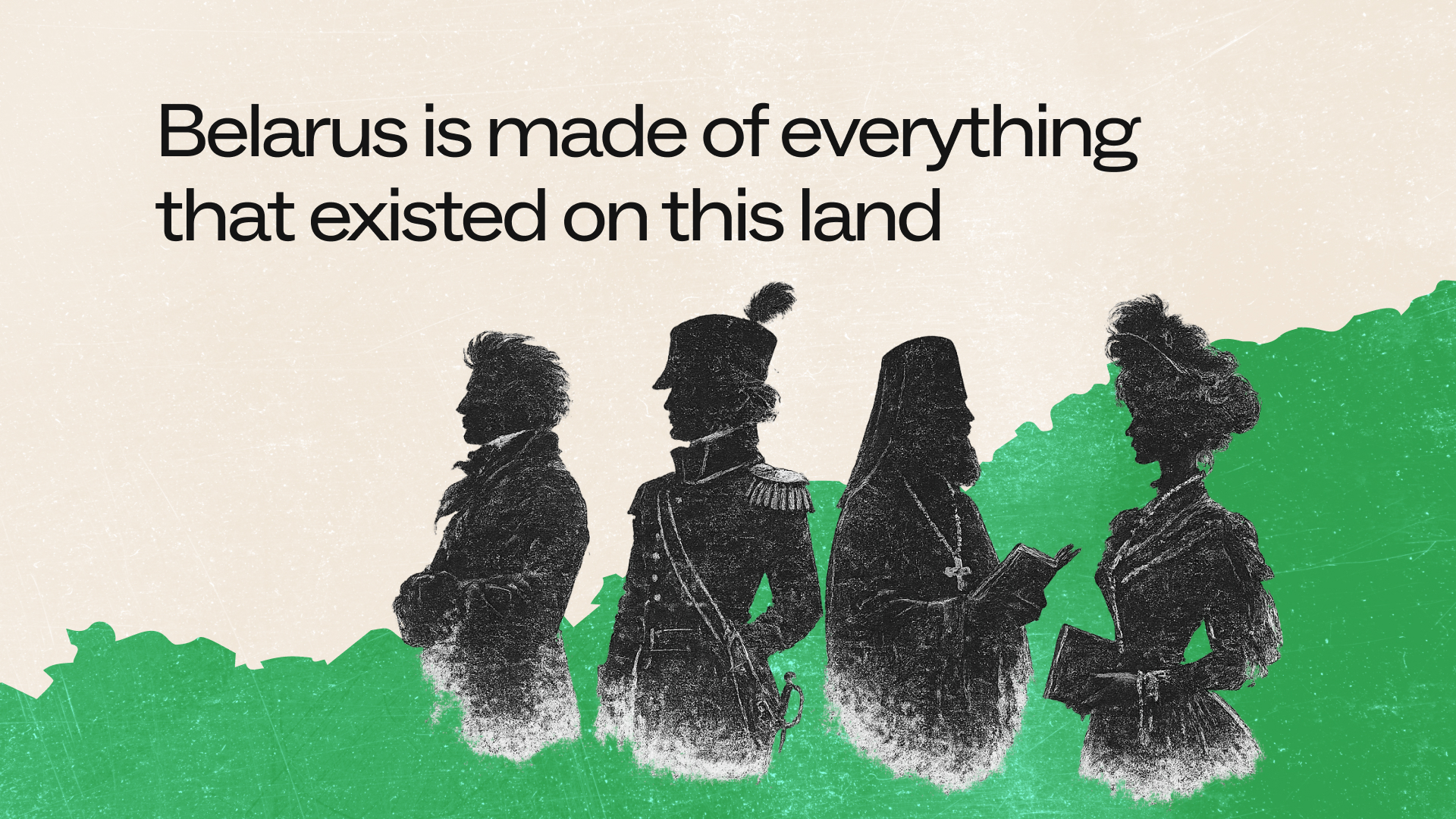
Belarus is made up of everything that came before us on this land. Regardless of state names, regardless of languages, regardless of whom the people of their era served. It is only when we reclaim this cultural heritage without exception that our country ceases to be an echo of a foreign history.
- Interesting fact: the Polish king and Grand Duke of Lithuania Władysław IV, whom Siemienowicz served, had — as a young prince at the outset of his royal career — spent a few years as Tsar of Moscow and of All Rus’.
- In the Lithuanian narrative, the Grand Duchy of Lithuania is presented primarily as the history of Lithuanian statehood; in the Polish, as part of the history of the Polish-Lithuanian Commonwealth and the Polish Eastern Borderlands; and in the Russian, as the past of the “Western Russian territories.
